
Kwasi Acheampong knows all too well the uphill battles faced by children from Worcester County’s low-income communities.
At age 10 and a freshly arrived immigrant from Ghana, Acheampong and his friend from Webster discovered his friend’s mother unconscious from an apparent drug overdose, a needle still in her arm.
“I didn’t know how to process it, but I just told myself I would never do drugs,” Acheampong said.
From that moment, Acheampong went on to build a career based on academic success. He graduated from Webster’s Bartlett High School, earned a degree in business administration from Worcester State University, and began working in accounting.
But his friend from that fateful playdate? He later died of an overdose.
After learning of his friend’s death, Acheampong decided he needed to do something. He settled on working to overcome the vast disparities in public school education in Worcester County.
Massachusetts public schools consistently rank among the nation's best by publications such as U.S. News & World Report, but access to the higher-performing districts is not equitably distributed. While districts may benefit from access to state programs, overall district performance varies widely, even within Worcester County.
Communities with higher median household incomes, such as Northborough and Southborough, generally have significantly better outcomes from their public schools, particularly in terms of college preparedness.
“I don’t think there was anyone who wasn’t going to college. I don’t think there was a single person,” said Ty Hill, who graduated from The Public Schools of Northborough and Southborough. “If you make it by the end of Algonquin [Regional] High School, nobody’s trying to [just] get a diploma.”
To help level the playing field for students from under-resourced school districts, Acheampong’s nonprofit Our Bright Future and organizations such as the Boys & Girls Club of Webster-Dudley and Blackstone Valley Hub for Workforce Development work with students to enhance their education and cut down on the out-of-school noise.
Same county, different outcomes
Webster and Southbridge, two towns where Acheampong now operates Our Bright Future, struggle to graduate their students at the same rates of districts in higher-income communities. Southbridge Public Schools is in state receivership, a designation and extensive support system for chronically underperforming schools.
The Webster and Southbridge school districts have graduation rates of 73% and 71%, respectively, according to Worcester County Insights, a data initiative from Greater Worcester Community Foundation and Worcester Regional Research Bureau.
Their graduation rates decline further when income status is taken into account. Webster graduates 65% of its economically disadvantaged students, and Southbridge graduates 69%.
Both of these communities have median household incomes below the Worcester County average of $88,524 from 2018-2022. In Webster, it’s $70,644, and in Southbridge, it’s $55,182.
Less than an hour east, students have very different experiences at the Northborough-Southborough Regional School District, which pulls from two of the wealthiest towns in Worcester County: Northborough and its $160,801 median household income and Southborough’s $186,432.
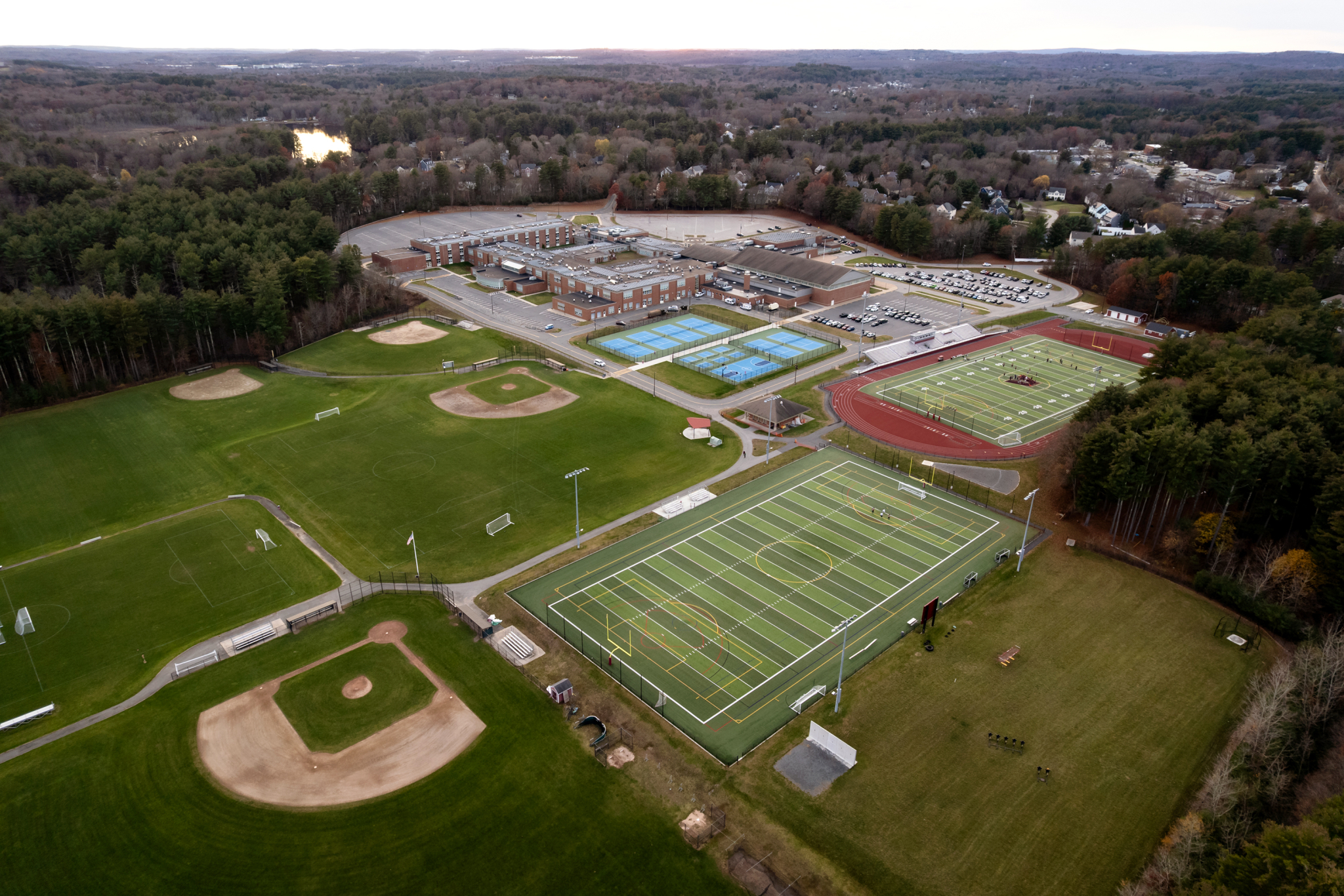
The district’s Algonquin Regional High School has a 98% graduation rate and a 93% graduation rate for its economically disadvantaged students, according to Worcester County Insights.
In 2024, Algonquin had 79% of its graduates enroll in a four-year institution, according to the Massachusetts Department of Elementary and Secondary Education.
These outcomes are expected at Northborough-Southborough, where preparation for college begins before students begin matriculating to public schools, if they go to public schools at all, said Northborough parent Marsha Hill, who moved to the district the week her daughter Ty turned 5.
“They were telling me that I already needed to know what I was going to do by seventh grade,” Ty said. The message was clear: “You need to start soon or else you’re going to be behind.”
What the data shows
Graduate rates and statewide standardized test scores show the vastly different educational outcomes for students from two of Worcester County’s wealthiest communities vs. two of its poorest ones.
Taking advantage of opportunities
Spurred by the financial crisis when she and her husband were younger, Marsha Hill said stable property values played a significant role in their decision to move to Northborough. When Ty was turned away from the private Fay School in Southborough, Hill chose to settle in Northborough rather than paying for extra educational and enrichment programs at a lower-tier school in a community where property values were not as consistent.
Algonquin Regional High School fluctuates in various available rankings and ranks No. 34 among Massachusetts high schools by U.S. News & World Report. Last year, it was No. 14.
“I had a theory, starting way back when, that there is low [real estate] inventory when your school district is top 20, and your property value isn’t going to depreciate that much,” Marsha said.
For Marsha, who immigrated to the United States from Jamaica when she was 7, quality education was an expectation. Her mother grew up in high society, attending both finishing school and British boarding school. When asked if her parents encouraged her education, Hill’s answer was simple: “There was not an option.”
A triple major at UMass Amherst, where she met her husband, Hill has strived to give Ty as many opportunities as possible. Spanish, swimming, and organized soccer before kindergarten. Tutors, sports, science, technology, engineering and math (STEM) summer programs. Ty has done it all.
The seeding for college begins early in Northborough. In middle school, Ty and her peers were charting out how their class schedules would position them for fitting in the math classes they needed to complete in high school in order to meet application requirements for various colleges and majors.
Ty fretted about completing Algebra 1 before her freshman year, as she had classmates already tackling Algebra 2 in the eighth grade.
“They even posted where we all went to college at the end, at our graduation,” Ty said.
Ty Hill is now studying nuclear engineering at Purdue University in Indiana.

Helping at-risk students
After he learned of his friend’s overdose death, Acheampong was both rattled and stumped. They had started out in the same place – same neighborhood, same public school system – and yet their lives had gone in opposite directions. Acheampong found himself grasping for an explanation.
He discovered the key difference was his participation in after-school and evening programming at the Boys & Girls Club of Webster-Dudley.
The programming kept him busy during the afternoons and evenings, ensured his homework was done, and connected him to movers and shakers who worked, volunteered, or oversaw the nonprofit.
“I can say that 100% of those kids who stopped going to the Boys & Girls Club, they started getting in trouble,” Acheampong said.
A child’s home life is one of the best indicators of academic success, but what happens to children who don’t have strong family foundations, stable living environments, or adults able to mentor them or pay for them to participate in enriching activities when school is not in session?
“These are all things that are being reserved for the most affluent areas,” said Ian Nugent, executive director of the Boys & Girls Club of Webster-Dudley.
In the Webster-Dudley region, children have little to do outside of school. Because of this, he said, they can end up idle. This idleness can translate into a lack of hope for their own futures.
“We’ve seen it firsthand, unfortunately. When moms and dads are busy and … they’re working and they don't have as much time, you have these latchkey kids,” Nugent said. “You have them out wandering the street. We’re trying to give them a place to go and be productive.”
At the Boys & Girls Club, members are provided homework help, educational programming, and a safe space. In addition to play, they work on social-emotional learning, financial literacy, exposure to different career fields, and connections to financial resources to pay for postsecondary schooling.
The club sees some of its most challenging students level out negative behaviors, Nugent said. Caregivers report their children are changed after participating at the club.
“That happens a lot,” Nugent said. “It’s why I work here, to be honest. Nothing makes you feel more fulfilled than seeing the change in your kids over the course of even one school year.”
At Our Bright Future, which has similar programming, Acheampong gains access to his students’ grades, emphasizing the importance of accountability.
To help prepare students for life after school, the Blackstone Valley Hub for Workforce Development offers workforce development programs, tailored to each partner school district’s needs from year to year. Among the goals of the program is to help make access to STEM education more equitable.
Even high-achieving students who plan to attend college after high school often need greater exposure to what opportunities are possible, said Joscelyn Young, president of BV Hub.
“They still need a lot of career awareness and education,” Young said. “They need to know a lot about themselves.”
School districts in southern Worcester County communities often face budget crises and have a difficult time passing Proposition 2 1⁄2 overrides to get students anywhere near the resources more common in higher-income districts, said Jeannie Hebert, who founded BV Hub and serves as its board chair.
“They just don't have the means to do this innovative programming,” Hebert said.
"Nothing makes you feel more fulfilled than seeing the change in your kids over the course of even one school year."
- Ian Nugent, Executive Director, Boys & Girls Club of Webster-Dudley.
Higher incomes, better resources
The average teacher salary in Southbridge Public Schools is $80,947, according to the Department of Elementary and Secondary Education. For teachers in Northborough-Southborough, it’s $104,873.
This translates into more spending per student. In Southbridge, $762 is spent per student on guidance, counseling, and testing. At Northborough-Southborough, $1,298 is spent per student in the same category.
Public schools are required to spend a minimum foundation budget on their students every year, enforced by the Chapter 70 state aid program. But school districts may choose to spend more.
In 2022, Webster Public Schools exceeded its foundation budget of $25.4 million by spending 112% of it on students.
In the same year, Northborough-Southborough spent 180% of its foundation budget.
In Northborough, Ty Hill described an ardently competitive educational culture. Students are attuned to building out their résumés for college applications from an early age.
This is not a community dominated by first-generation college applicants. Parents often went to college themselves, have careers, and may have waited until they were professionally and financially established before they had children, as Ty’s mother did.
The mindset is not whether a student will go to school, but rather, how to meticulously plan to reach the desired outcome. Counselors at Algonquin, Ty said, checked in with students approximately twice a year, inquiring about college plans and strategically building schedules to support applications.
“I got, like, a huge push,” she said. “It’s like networking without having to talk to anyone. I just got a huge push.”
This story was commissioned by Greater Worcester Community Foundation through the Worcester County Insights Reporting Project. The project supports independent reporting on issues affecting Worcester County communities.
Disclosure: Our Bright Future and The Boys & Girls Club of Webster-Dudley, which are featured in this article, have received funding from Greater Worcester Community Foundation.